



Yellow
Flower Color

Non Fragrant
Fragrance

Winter
Flowering Season

Lithops
Genus

Low
Maintenance

Yes
With Pots

Small
Size

Outdoor Shade,Outdoor Sun
Sunlight Requirement

Twice A Week
Water Requirement
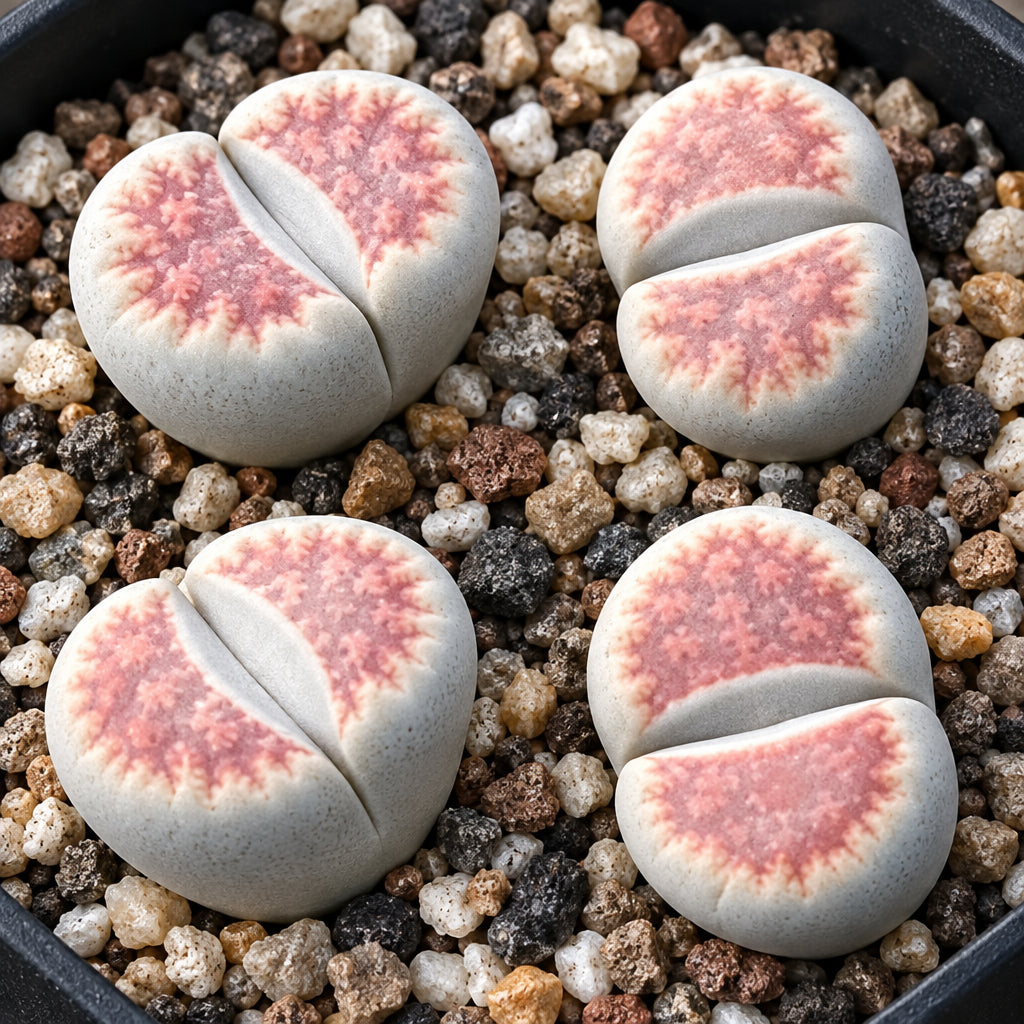
Stone-Like Succulent with Intricate Pinkish-Red Markings
Lithops karasmontana var. lateritia, commonly known as a Living Stone Plant, is a fascinating miniature succulent belonging to the Aizoaceae family and native to Namibia. Its remarkable stone-like appearance allows it to blend naturally with rocky surroundings, while the attractive markings on its leaf tops give each plant a distinctive ornamental character. This compact succulent is particularly valued by collectors of unusual and miniature plants.
The plant consists of a pair of thick, fused succulent leaves forming a compact, almost stemless body. The rounded to slightly flattened leaf tops display pinkish-red, reddish-brown and muted earthy markings over a pale stone-like background, creating an intricate natural pattern. Individual bodies generally remain small, reaching approximately 2.5–3 cm in height. As the plant develops, a new leaf pair emerges from within the old leaves, while the older leaves gradually shrivel and are absorbed by the new growth.
Flower Colour & Blooming
When mature, Lithops karasmontana can produce attractive white flowers that emerge from the central fissure between the paired leaves. Flowering generally occurs in late summer to early autumn, with the flowers opening above the compact stone-like body.
Environment
Sunlight: Provide bright light with several hours of gentle direct sunlight. A sunny location helps maintain compact growth and enhances the natural colour and markings of the plant. Protect it from excessively harsh heat through suitable ventilation and gradual acclimatization.
Watering: Water sparingly and only when the plant is in its active growth period and the growing medium has dried completely. Lithops have a pronounced seasonal growth cycle and should generally be kept very dry during their resting and leaf-replacement periods. Avoid frequent watering or allowing water to remain around the plant.
Soil: Use a very well-drained, gritty succulent or cactus growing medium. A mineral-rich mix with excellent drainage is important because the plant is highly susceptible to problems caused by excess moisture around its roots.
Fertilizer: Feed sparingly during active growth with a diluted, balanced fertilizer formulated for succulents. Avoid excessive feeding, as Lithops are slow-growing plants adapted to nutrient-poor environments.
Growth & Seasonal Cycle
Lithops follow a distinctive annual growth cycle. A new pair of leaves develops from within the older pair, gradually replacing the previous growth. During this process, the older leaves naturally become thin and dry as their stored moisture and nutrients are transferred to the new leaves. This natural renewal should not be mistaken for plant damage.
Landscape & Décor Uses
- Ideal for succulent and cactus collections.
- Excellent for miniature gardens and decorative succulent arrangements.
- Suitable for small pots and tabletop plant displays.
- A fascinating collector's plant for windowsills and bright indoor spaces.
- Its stone-like appearance makes it an unusual focal point in rock-inspired displays.


