
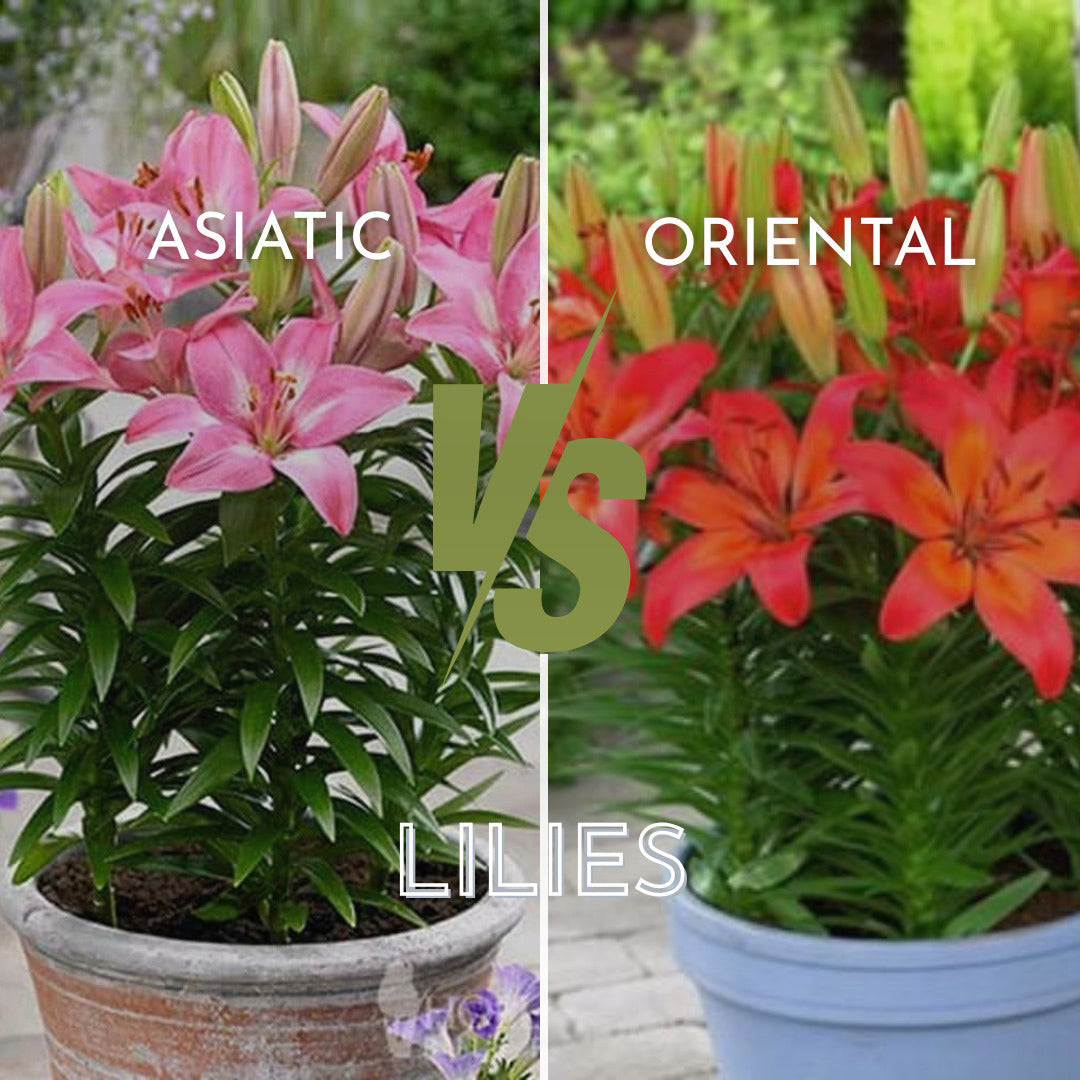
Difference Between Asiatic & Oriental Lily Flowers: A Complete Guide
In India, lilies are among the most popular flowering bulbs grown for their vibrant colours, elegant form, and delightful fragrance. Two of the most loved varieties—Asiatic lilies and Oriental lilies—belong to the Lilium genus but differ significantly in appearance, fragrance, bloom time, and growing behaviour. Understanding these differences will help you choose the perfect lily for your home garden or floral arrangements.
🌸 Flowering & Fragrance
Asiatic lilies bloom early in the season, typically from late May to early June. Their upward-facing flowers come in a wide spectrum of colours—orange, yellow, pink, red, and white. The petals are smooth and sometimes speckled, giving them a bright, cheerful appearance. Asiatic lilies have little to no fragrance, making them ideal for those who prefer colourful blooms without strong scents.
Oriental lilies bloom later, usually from July to August. They produce large, exotic-looking flowers with gracefully recurved petals in shades of white, pink, and red. Oriental lilies are famous for their strong, sweet fragrance, which intensifies in the evening—perfect for moon gardens and scented bouquets.

🌱 Planting Season in India (Quick Comparison)
Both Asiatic and Oriental lilies grow well in India, but their ideal planting windows differ slightly due to their growth habits.
- Asiatic lilies can be planted from October to January in most Indian plains, and from February to April in hill regions. They sprout quickly and adapt well to warmer zones.
- Oriental lilies prefer cooler conditions and are best planted from November to January in plains, and from February to April in hills. They take longer to sprout and benefit from a cooler start.
For a detailed region-wise guide on planting seasons, soil preparation, fertilizers, and pest management, explore our upcoming article on Lily Care in Indian Conditions.
🌿 Growth & Care Differences
Asiatic lilies are fast-growing, low-maintenance, and cold-hardy. They thrive in full sun to partial shade and naturalize easily, returning year after year. Their minimal care requirements make them perfect for beginners and busy gardeners.
Oriental lilies grow slower but reward gardeners with dramatic, showy blooms. They prefer rich, slightly acidic soil and require more moisture and organic matter. Oriental lilies are somewhat sensitive to cold and benefit from winter mulching, especially in northern plains.
🍃 Leaf Shape
Asiatic lilies have narrow, lance-shaped leaves arranged in whorls along the stem. Their foliage is lighter green and complements their bright blooms.
Oriental lilies feature broader, glossier leaves in a deeper green shade, adding lush texture to the garden even when not in bloom.

🌼 Uses in Gardening & Landscaping
Asiatic lilies are ideal for borders, flower beds, and containers. Their sturdy stems make them excellent cut flowers, and their early-season blooms add vibrant colour to gardens.
Oriental lilies are perfect for perennial gardens and mixed borders. Their enchanting fragrance makes them ideal for planting near patios, windows, or seating areas. They also elevate floral arrangements with elegance and longevity.
🌸 Lily Trivia
- Asiatic lilies are among the easiest lilies to grow—perfect for beginners.
- Oriental lilies are widely used in perfumes due to their intoxicating scent.
- Some lilies are toxic to cats—pet owners should plant with caution.
- The Madonna Lily (Lilium candidum) is one of the oldest cultivated lilies, symbolizing purity and renewal.
🌺 Which One Should You Choose?
If you want early blooms, low maintenance, and a wide colour range, choose Asiatic lilies. If you prefer large, dramatic flowers with a strong fragrance, Oriental lilies are the perfect choice.
For a long-lasting display, plant both varieties and enjoy blooms from early summer to late monsoon.
Explore all flowering bulbs available at myBageecha, including a wide range of lily bulbs for your home garden.