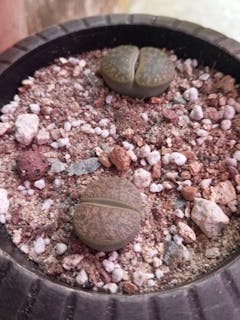
1.Proper soil preparation is crucial for planting bulbs successfully. Well-draining, loose soil enriched with compost or leaf mold. Ensure excellent drainage; if your soil is clay-heavy, mix in some coco peat.
2.Ensure the bulbs receive 4 to 6 hours of sunlight daily, adjusting the light exposure according to the specific variety—some prefer partial shade while others require full sun.
3.Plant bulbs at a depth two to three times their height (e.g., a 2 cm bulb goes 4–6 cm deep) with spacing depending on size, typically 5–15 cm apart.
4.Water lightly after planting, keep soil moist but not waterlogged during growth, and reduce watering after flowering to let foliage yellow and bulbs enter dormancy. 5.Apply a low-nitrogen, high-potassium fertilizer when shoots emerge and post-bloom.
6.Avoid cutting green leaves immediately after flowering to allow energy storage.
7.Prevent pests and diseases by avoiding overwatering and treating bulbs with neem oil or mild fungicide before planting.
8.Store bulbs off-season by cleaning, drying in shade, and keeping them in breathable containers at 10–20°C with moisture absorbers; avoid sealed plastic and humid conditions.


Daily
Water Requirement

Green
Flower Color

Non Fragrant
Fragrance

Winter & Spring
Flowering Season

Gladiolus
Genus

Medium
Maintenance

No
With Pots

Small
Size
Autumn
Sowing Season

Outdoor Shade,Outdoor Sun
Sunlight Requirement

Balcony,Low Maintenance
Use
Sword Lily
Family
Iridaceae
Origin
India
Description
Gladiolus are beautiful plants, grown from corms or bulbs, and a favorite of many gardeners. They are perennials with striking flowers and tall long stems that grow 2 to 6 feet in height. It is also known as the Queen amongst the bulbous flowers.
Gladioli grow from rounded, symmetrical corms, (similar to crocuses) that are enveloped in several layers of brownish, fibrous tunics.Their stems are generally unbranched, producing 1 to 9 narrow, sword-shaped, longitudinal grooved leaves, enclosed in a sheath.The lowest leaf is shortened to a cataphyll. The leaf blades can be plane or cruciform in cross section.
The flowers of unmodified wild species vary from very small to perhaps 40 mm across, and inflorescences bearing anything from one to several flowers. These flowers are variously coloured, ranging from pink to reddish or light purple with white, contrasting markings, or white to cream or orange to red.
The flower spikes are large and one-sided, with secund, bisexual flowers, each subtended by 2 leathery, green bracts. The sepals and the petals are almost identical in appearance, and are termed tepals. They are united at their base into a tube-shaped structure. The dorsal tepal is the largest, arching over the three stamens. The outer three tepals are narrower. The perianth is funnel-shaped, with the stamens attached to its base. The style has three filiform, spoon-shaped branches, each expanding towards the apex..
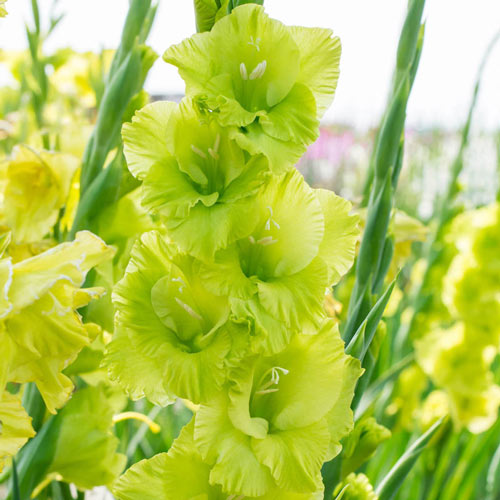
Gladiolus 'Green Star' -is a highly unusual color, blooming in bright green flowers.. There are upto 6 to 8 florets per stem.
Gladiolus Green Star bulbs are prized for their rare green blooms, adding exotic flair to summer gardens. Flowers Nov–Feb (plains), Dec–Mar (hills). Plant Aug–Oct (plains) or Aug–Sep (hills).
Environment
Gladioli like well-drained soil and full sun. Using a garden fork or tiller to loosen the soil to about 12 to 15 inches deep. After loosening the soil, mix in a 2- to 4-inch layer of compost or aged manure. Plant bulbs 3 to 6 inches deep and 2 to 3 inches apart with the flat side down. After planting bulbs, water them generously. Soak the soil so that it settles around the bulb.
Water the plants periodically. It is better to provide a good weekly soaking than to water them lightly two or three times a week. The roots and stems will appear shortly after their first watering.
It takes about 60 days from the time gladioli are planted for the corms to root, grow, bloom. Once your flowers have started blooming, you can leave them on the plant or cut them to make a striking flower arrangement. If you choose to leave the flower on the plant, cut off the dead head to guarantee continuous growth. When the flowers stop blooming, do not cut down the foliage. The leaves continue to produce food that is stored in the corm for the next year s season of flowers. After the blossoms have faded, water the bulbs regularly. The leaves will start to turn yellow and brown and eventually dry up. When this happens, empty the pot. Recover the bulbs and allow the soil that sticks to to them to dry. Remove dead foliage, brush off dry soil, and store the bulbs in a cool, dry place. They will be ready for the next year.
Landscape Use
It is a beautiful addition to any garden, and makes a wonderful container plant.