

Non Fragrant
Fragrance

Summer
Flowering Season

Huernia
Genus

Low
Maintenance

Multicolor
Color

Yes
With Pots

Small
Size

Outdoor Shade,Outdoor Sun
Sunlight Requirement

Twice A Week
Water Requirement

Low Maintenance,Outdoor,Window Ledge
Use
Porcupine Huernia
Family
Asclepiadaceae
Origin
South Africa.
Description
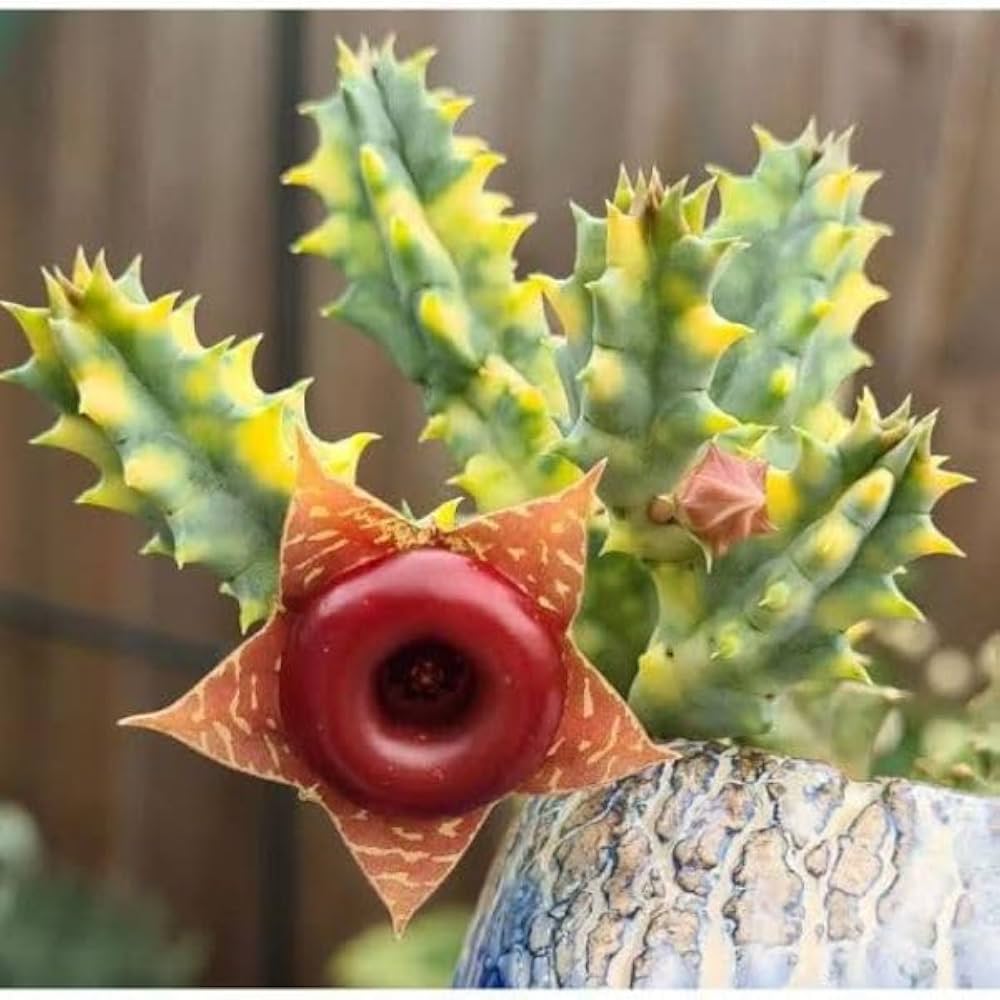
Huernia Zebrina Variegata is a low-growing perennial succulent species more or less creeping, occasionally forming mats. It is one of the most beautifully flowering huernias and very popular in cultivation for its odd blooms. It has a raised, glossy, wine-red ring or 'annulus' around the mouth of the corolla tube. The corolla varies in size and is usually patterned with wine-red zebra stripes which vary conspicuously in colour intensity. One of the so-called lifebuoy huernias because of the glossy raised annulus.
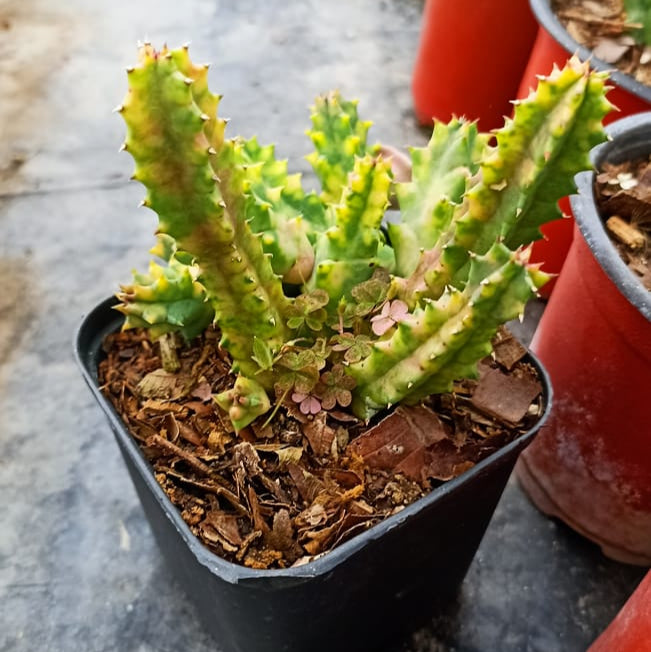
The stems are adorned with yellow streaks and patches against a green backdrop, making it an exceptionally decorative plant. Their appearance is of a decumbent-erect nature, with a loosely-branched structure and tapering shape. They display prominent angles of 5 to 6, and exhibit irregular branching, measuring 5 cm in length and 12 mm in diameter. The stems are also strongly toothed, with teeth measuring 4.5 mm in length.
The flower has a recognizable zebra-like pattern due to its yellow and red stripes and five pointed star-shaped lobes. At the center of the flower is a distinct glossy, red-purple ring in the shape of a donut.
Environment
Huernias prefer bright light or partial shade. In nature, they grow underneath shrubs or other plants. Too much sun causes stems to develop protective reddish or purple pigmentation and can actually scald the stems. Too little light leads to weak, thin growth with decreased flower production.These plants grow best between 10 and 27 C. Protect them from freezing weather..
Huernias require a potting mix with excellent drainage. A succulent plant mix of 50 percent perlite, 25 percent vermicompost and 25 percent sand helps prevent rotting and over watering. Roots experience die back in cool-season dormancy, so plants grow best in shallow containers that allow the soil to dry out quickly. Using clay pots further helps soil from staying too wet. An underlayment of coarse gravel below the soil mix also improves drainage. In climates with damp cool summers, a layer of gravel between the plant and the soil mix also helps prevent the stems from staying too moist. Outdoor plantings do well in raised beds.
Landscape Use
Suitable for Container, Rock Garden & Xeriscaping.Spreads by creeping or trailing stems, great for hanging baskets or shallow pots.